Imagine the effect of caffeine as sand falling through an hourglass. For most of us, the neck is narrow—the sand falls steadily, providing several hours of stable alertness. However, for a tobacco smoker, that neck undergoes a drastic widening.
The grains fly through nearly twice as fast. The result? The time caffeine actually “works” for you is cut short, and the bottom of the hourglass fills up before you’ve even fully utilized your morning boost. This isn’t a subjective feeling; it’s pure biochemistry.
The “Speed Demon” in Your Liver: Meet CYP1A2
The culprit behind this accelerated “leak” is an enzyme known as CYP1A2. Think of it as the primary mechanic in our liver, responsible for dismantling caffeine molecules. Under normal conditions, this mechanic works at a steady pace. However, the hydrocarbons in tobacco smoke act like a high-octane fuel for this enzyme, making it work on extreme overtime.
The 50% Rule: Why Smokers Need More Coffee
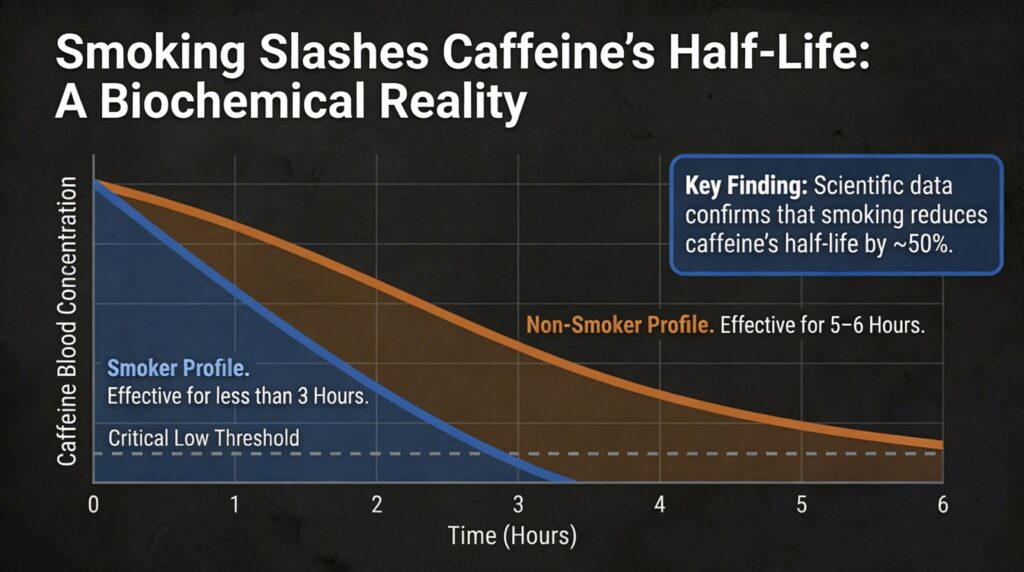
Scientific data is remarkably consistent on this point: in smokers, the caffeine half-life is approximately 50% shorter than in non-smokers.
- The Average User: Caffeine stays active for 5–6 hours.
- The Smoker: Caffeine levels drop to critical lows in less than 3 hours.
This is why smoking almost always goes hand-in-hand with reaching for that extra cup. One habit literally “evicts” the other from your system.
The Quitter’s Trap: When the Smoke Clears
It is worth noting one specific “catch”: it isn’t the nicotine itself that goads our enzymatic mechanic into overdrive, but the polycyclic aromatic hydrocarbons (PAHs) found in tobacco smoke. The real challenge arises the moment you decide to quit. When the smoke clears, the CYP1A2 enzyme slows down to its natural pace almost overnight. The effect? That “safe” afternoon dose of coffee you’ve been used to suddenly stays in your bloodstream twice as long. If you don’t adjust your caffeine schedule, a late-day cup that previously allowed you to sleep soundly might now trigger jitters, anxiety, and a sleepless night. It’s a moment where your body’s biochemical map resets to factory settings, requiring a completely new strategy for managing your daily rhythm.
Don’t Just Guess—Measure Your Metabolism
The takeaway? A smoker might think with pride: “At least my liver is a speed demon.” A devoted caffeine lover might sigh in relief: “At least I don’t need a subscription for my coffee.”
Jokes aside, the biochemical world doesn’t accept simple scripts. What you eat, drink, or inhale creates a web of dependencies that you cannot “feel” by guesswork. Until you start measuring these correlations, you are just a passenger in your own body. And driving without a map is expensive—especially given current prices for good coffee in the city 🙂 To find out how your lifestyle impacts your alertness, you can check your profile using our Caffeine Metabolism Calculator.
References:
- Faber MS, Jetter A, Fuhr U. Assessment of CYP1A2 activity in clinical practice: why, how, and when? Basic Clin Pharmacol Toxicol. 2005 Sep;97(3):125-34. doi: 10.1111/j.1742-7843.2005.pto_973160.x. PMID: 16128905.
- Zevin S, Benowitz NL. Drug interactions with tobacco smoking. An update. Clin Pharmacokinet. 1999 Jun;36(6):425-38. doi: 10.2165/00003088-199936060-00004. PMID: 10427467.

Leszek Całka
Head of Curiosity @ Vitascopium
An engineer and software developer. As a certified ISO 9001 Auditor and IT author for Helion Publishing, I bridge the gap between hard data and human curiosity. I run my digital laboratory from a historic Water Tower in Gliwice, Poland.